Tips & Guides
The Best App to Track Workouts, and What Actually Matters
What is the best app to track workouts?
The best app to track workouts is the one that gets your sets logged in under ten seconds and shows you, in one screen, whether you are lifting more than you were a month ago. Everything else is decoration. Speed of logging and a clear view of progression are what separate a tracker that changes your training from one that just records it.
That is the short answer. The longer answer is that the app is the easy part. What most people are actually missing is not a better logging screen, it is a programme worth logging.
Why track workouts at all?
Because progressive overload is the mechanism that builds strength and muscle, and you cannot apply a mechanism you cannot see.
Progressive overload just means doing slightly more over time: more weight, more reps, better control, less rest. It is not complicated, but it is invisible without a record. Ask someone who trains without tracking what they benched six weeks ago and you will get a guess. Ask someone who tracks and you get a number, and a number is something you can beat.
Training without a log is not training, it is exercising. Both are better than the couch, and the physical activity guidelines will tell you the couch is the real enemy. But if you want the body composition to change, you need the record.
What should a workout tracking app actually do?
Five things. Log fast, show progression, hold your routine, work offline, and get out of your way.
- Log fast. You are standing between sets with chalky hands. If entering three sets takes more taps than the set took reps, you will stop doing it by week three.
- Show progression. Last session's weights and reps visible before you lift, and a chart per exercise. If you have to go hunting for what you did last time, the app has failed at its one job.
- Hold your routine. Your programme should load as a template, not be rebuilt every session.
- Work offline. Gym basements eat signal. The log should not.
- Stay out of the way. Rest timer, plate calculator, done. Social feeds and streak badges are not training.
A few second tier features are worth having if they come free: personal records flagged automatically, estimated one rep max per lift, weekly volume per muscle group, somewhere to log body weight and measurements, and the ability to export your data so a decade of training is not trapped in someone's subscription. Apple Watch or wearable support is a nice to have, not a decider, and most good loggers have a free version that does everything a lifter needs.
Things that sound important and mostly are not: enormous exercise libraries, calorie estimates from your watch, and AI that invents a new workout every session. A programme that changes every week is a programme you cannot progress.
Which workout tracking apps do people actually use?
The well known ones split roughly into gym loggers and everything else, and for strength training the loggers win.
Apps like Hevy, Strong, Jefit and FitNotes are built around the set, rep and weight log, with routines saved as templates, supersets handled properly and progress charts per exercise. That is what a lifter needs. Fitbod sits slightly apart because it generates the session for you. Strava and the watch based apps are excellent at cardio and largely beside the point in a squat rack.
We are not going to rank them for you, because the honest answer is that any of the dedicated loggers will do the job, and the differences between them matter far less than whether you open one. Try two for a fortnight and keep whichever you stopped noticing.
What most trackers cannot do
They cannot tell you whether the plan you are logging is the right plan. That is the gap, and it is the expensive one.
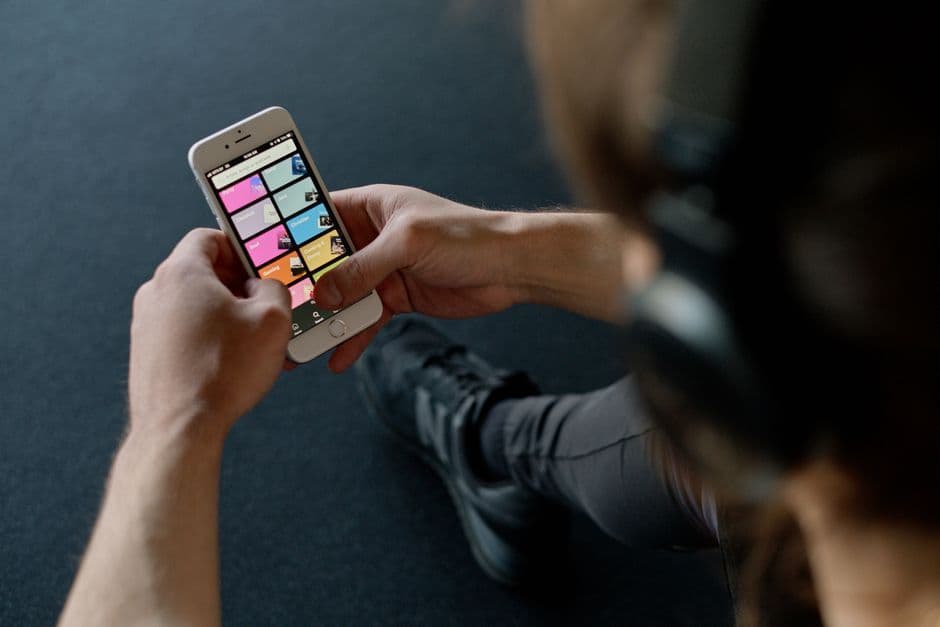
 A person holds a smartphone showing a fitness app with step count and distance tracking outdoors.
An app will happily record twelve weeks of the same four exercises at the same weight and show you a flat line. It will not tell you that your sets are two reps short of the range that drives growth, that you are training chest three times a week and legs never, that your deload is overdue, or that your protein intake is the reason the strength has stalled. It records. It does not coach.
This is the difference between tracking and programming. Tracking is the log. Programming is what should be in it, and it is where the actual results come from. If you want the mechanism in full, how to build muscle sets out the four levers, and protein intake is usually the one people get wrong. Sports Dietitians Australia has a straight, evidence based summary of the numbers.
Does an app replace a coach?
No, and the honest reason is accountability rather than knowledge, because the information was never the bottleneck.
Most people who stall do not stall because they lacked information. Information has never been cheaper. They stall because nobody looked at their numbers, told them the truth about the last three weeks, and adjusted the plan before the plateau turned into a break. An app is a mirror. A coach is a mirror that talks back and then changes something.
That is the whole design of online coaching: a programme built for you, logged, checked weekly, and adjusted while it is still fixable.
Where the FitCult app fits in
Your coaching lives in one hub. The FitCult app, coming soon, holds your programme, progress tracking, check-ins, nutrition and direct messaging with your coach in one place, so the log and the plan finally sit in the same app instead of two. Until it launches you get the same coaching through our current tools, then move across when it goes live.
How long before tracking shows anything?
Give it four to six weeks before you judge the numbers, and one week before you judge the habit.
Strength moves before the mirror does. In the first month you should see load or reps creeping up on your main lifts even if nothing looks different yet, and that early data is what keeps people going through the boring part. Body composition follows, which is the pattern we walk through in body recomposition.
Start with the programme, not the app
Download whichever logger you like the look of, that decision is genuinely low stakes. The one worth thinking about is what goes into it.
If you want a programme built around your goal, your schedule and your actual starting point, and someone checking the numbers with you every week, that is what we do. Book a free intro session with FitCultInc around Wentworth Point and Rhodes, or start online coaching from anywhere in Australia.
Built, not born.
Get an honest quote for your place
A free quote, no obligation, and the price we give is the price you pay.